Top 7 Revenue Cycle Management (RCM) Companies of 2026

Without the necessary cash flow, medical practices can’t properly care for their patients. That’s why, although healthcare organizations focus on serving patients, finances are an important element that can’t be overlooked.
Medical finances contain a lot of moving parts, from accepting patient co-pays to billing insurance agencies. It’s essential to assess your revenue cycle as a whole and invest in solutions that make revenue cycle management (RCM) easier. By doing so, you’ll reduce the administrative burden on your staff and improve your medical practice’s financial health.
In this guide, we’ll look at RCM companies that deliver the solutions you need for better financial health. We’ll cover:
Revenue cycle management is as important to a medical practice as lungs are to a patient. By implementing the right software and practices now, you can set up your medical organization for a stronger financial future.
Top RCM Companies*
| Company Name | Core Features | Best Fit For |
| PracticeSuite | Comprehensive RCM tools Enterprise claims management KPI dashboard and reporting | Small and mid-sized medical practices Billing service groups |
| Oracle | Financial clearance Contract management Insurance management | Hospitals Healthcare payers and insurance groups |
| Greenway Health | Specialty-specific financial care team Medical coding Expedited implementation | Ambulatory practices |
| Conifer Health Solutions | Revenue cycle outsourcing A/R management Financial risk management | Hospitals Health systems Physician groups |
| CureMD | Patient financial experience optimization AI automation Denial resubmissions | Multispecialty groups Medium to large practices |
| athenahealth | Automation Gamification Interoperability | Large practices Health systems Billing services Hospitals |
| CorroHealth | Coding Claims management Denials prevention | Healthcare systems |
1.

PracticeSuite
Best for: Small and mid-sized medical practices, billing service groups
Capterra Rating: 4/5
G2 Rating: 4.3/5
I am thoroughly satisfied with PracticeSuite. Switching over to PracticeSuite has allowed me to bill my patients more efficiently and in turn made more money for my practice.
If you’re looking for comprehensive software that covers RCM, practice management, EHR, and more, PracticeSuite is the right choice for you. We’ve delivered secure, cloud-based solutions to small to mid-sized medical practices and billing service groups for over 20 years, serving 61+ clinical specialties.
Our mission is to help doctors practice profitably by providing exceptional RCM software. Our RCM tools include:
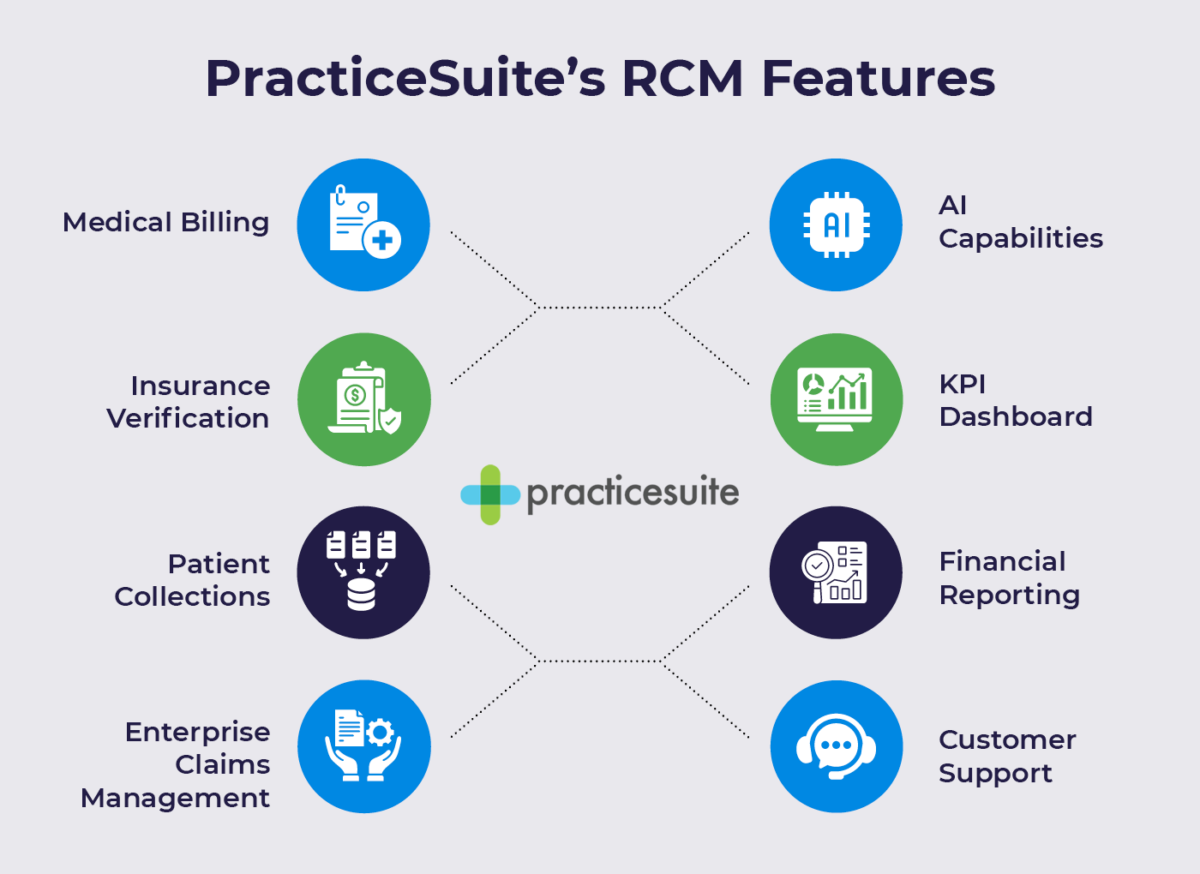
- Medical billing: Streamline and accelerate your entire revenue cycle, from patient payments to final insurance reimbursement. Navigate billing accounts for all patients across multiple practices to ensure you get paid.
- Insurance verification: Verify patient insurance eligibility immediately so you always know how much to charge for co-pay and other fees. Obtain prior authorization for services that need it so you can treat patients knowing that their insurance will cover them.
- Patient collections: Establish a straightforward, convenient payment process to promote timely patient collections for their portion of the medical bill.
- Enterprise claims management: Handle rejections, denials, payment posting, and mass claims corrections in a single dashboard.
- AI capabilities: PracticeSuite offers AI capabilities to smooth out your medical practice’s RCM. Their features include denial intelligence that identifies claim issues before submission, and automated posting based on predefined rules to reduce manual entry and minimize errors.
- KPI dashboard: Monitor your RCM performance in real time with a single centralized dashboard that displays everything from key performance indicators to claim denials to payments.
- Financial reporting: Access all the data you need to make informed RCM decisions and achieve long-term financial stability.
- Customer support: Our RCM billing tools include reliable customer support that’s there for you 24/7.
PracticeSuite brings decades of medical billing and revenue cycle experience to your medical practice, supplying you with all the tools you need to handle RCM. With our RCM software and services, you’ll gain deep insight into your revenue cycle, enabling you to achieve maximum profitability.
Why PracticeSuite Stands Out
While many RCM vendors force medical practices into rigid software systems that include more features than they need, PracticeSuite offers a comprehensive, all-in-one approach combined with a flexible, modular design. Users can access enterprise-grade claims management, AI-driven claim scrubbing, and highly customizable KPI dashboards that scale alongside the clinic.
Beyond its high-quality software, PracticeSuite distinguishes itself by supporting over 60 clinical specialties and catering directly to third-party billing service groups. These capabilities allow PracticeSuite to function as a true revenue partner that understands the specific coding nuances and workflow requirements of distinct medical fields.
Practice profitably with PracticeSuite.
We offer revenue cycle management software and services to ensure you get paid for patient care. Click to book a demo.

2.

Oracle
Best for: Hospitals, healthcare payers, and insurance groups
Capterra Rating: 3.8/5
G2 Rating: 4.1/5
Oracle offers technological solutions for various industries, helping businesses transform their operations and adopt a data-driven approach. For healthcare clients, this RCM company’s tools provide actionable health insights that automate processes and optimize resources.
A few of their standout features include:
- Financial clearance: Evaluate whether existing data is accurate and up to date to minimize the amount of information patients are asked to verify during preregistration or on arrival.
- Contract management: Manage payer contracts by viewing net receivables upon charge posting, offering detailed patient responsibility breakdowns, and supporting real-time reimbursement calculations.
- Insurance management: Enable healthcare insurers to offer a transparent member experience with better policy administration, faster premium calculations, and quicker benefits adjudication.
Why Oracle Stands Out
Oracle brings unmatched data processing power to the RCM space, bridging the gap between massive hospital systems and insurance payers. By serving both sides of the healthcare equation, this platform delivers exceptional interoperability and transparency for high-volume environments. Its core strengths lie in complex contract management and financial clearance, making it a top option for enterprise networks that need to accurately process massive claim volumes and navigate intricate payer agreements.
3.

Greenway Health
Best for: Ambulatory medical practices
Capterra Rating: N/A
G2 Rating: 3.3/5
Greenway Health provides healthcare technology to over 10,000 ambulatory practices, including RCM software. Its RCM tools empower healthcare providers to optimize revenue and better manage their practice’s finances, delivering a personalized approach to revenue cycle partnership that supports its clients’ unique practice goals.
This RCM company’s standout features include:
- Specialty-specific financial care team: Work with a certified financial care team that aligns with your specialty to ensure your staff members are supported.
- Code auditing: Greenway Health’s team of experts can audit your medical practice’s coding practices. This RCM company also offers a range of coding services from full-service coding to targeted support for complex cases.
- Expedited implementation: Greenway Health works with you to optimize your system configuration and implement your new RCM software as soon as possible to quickly elevate your RCM success.
Why Greenway Health Stands Out
Greenway Health differentiates itself by pairing its software with a human-centered approach, specifically through its specialty-aligned financial care teams. This partnership opportunity is a massive advantage for ambulatory practices that lack the staff expertise for deep medical coding analysis. By providing targeted code auditing, expedited implementation, and expert guidance, Greenway Health acts as a seamless extension of a clinic’s back office to prevent revenue leaks and minimize coding errors.
4.

Conifer Health
Best for: Hospitals, health systems, and physician groups
Capterra Rating: N/A
G2 Rating: N/A
Conifer Health provides revenue cycle and value-based care solutions that optimize financial performance. With this RCM company’s tools, you can elevate your healthcare experience, acquire appropriate reimbursement, and improve access to care within your community.
Conifer Health’s solutions include:
- Revenue cycle outsourcing: Reshape your current revenue cycle by improving patient experience, clinical revenue integrity, and billing with technology-enabled solutions and intelligent process automation.
- A/R management: Increase cash collections and optimize yield by ensuring clean claims, compliant billing, denials management, and more.
- Financial risk management: Work with Conifer Health to create a coordinated and optimized system for claims expense and care patterns.
Why Conifer Health Stands Out
Conifer Health excels at taking a holistic view of financial risk management, specifically guiding large health systems through the complex transition from fee-for-service to value-based care models. By emphasizing clinical revenue integrity and intelligent process automation, Conifer Health empowers large organizations to maximize yield while maintaining strict billing compliance.
5.
CureMD
Best for: Multispecialty groups and medium to large practices
Capterra Rating: 3.6/5
G2 Rating: 3.2/5
CureMD provides health information systems and services to healthcare organizations, covering tools from credentialing to medical billing. Its RCM tools enable medical practices to accelerate cash flow and reclaim staff time.
Its standout features include:
- Patient financial experience optimization: Give patients access to price estimations, easy-to-understand bills, online payment options, and self-service options to offer a better financial experience.
- AI automation: Automate tasks like claims processing, payment posting, and denial management to reduce staff workload and improve accuracy.
- Denial resubmissions: Resolve claims in under three days by resubmitting claims and making appeals through CureMD’s solutions.
Why CureMD Stands Out
CureMD tackles one of the hardest parts of modern RCM—collecting patient balances—by delivering exceptional consumer-facing tools. Behind the scenes, its native AI drastically reduces manual workloads for multispecialty groups. Routine tasks are automated, and advanced denial resubmission tools actively resolve rejected claims, accelerating overall cash flow.
6.

athenahealth
Best for: Large practices, health systems, billing services, and hospitals
Capterra Rating: 3.8/5
G2 Rating: 3.6/5
athenahealth offers an RCM solution that allows medical organizations to get paid faster, with less work by increasing automation, reducing redundancies, and fostering best practices.
This RCM company’s top features include:
- Automation: athenahealth provides powerful automation tools that evaluate and perform routine A/R follow-up tasks, independent of your team.
- Gamification: Boost staff productivity with this RCM company’s gamification tools, which allow billing employees to earn points for their performance and compete with other team members.
- Interoperability: athenahealth’s RCM solution integrates with all leading electronic medical record (EMR) solutions, ensuring your tools remain interoperable.
Why athenahealth Stands Out
athenahealth leverages a massive cloud network to continuously update its billing intelligence. When a denial trend or payer rule change is identified anywhere in the network, those “learned” rules are instantly applied to all users to prevent repeat errors. Additionally, athenahealth brings an innovative “gamification” element to the back office. By allowing billing staff to earn points and compete on productivity metrics, it transforms tedious A/R follow-up into a highly engaging, efficient workflow.
7.

CorroHealth
Best for: Healthcare systems
Capterra Rating: N/A
G2 Rating: N/A
CorroHealth provides end-to-end RCM tools that align patient care, operational efficiency, and financial health. Its tools cover front-end operations, mid-cycle processes, and end-cycle actions to redefine RCM and drive further financial resilience.
This RCM company’s top features include:
- Coding: Maximize the value of your claims by automating your coding processes or outsourcing them to CorroHealth’s expert coders.
- Claims management: Leverage CorroHealth’s tools to ensure claims are accurate, compliant, and optimized for first-pass approval.
- Denial prevention: Expertly navigate denials with the help of advanced data analytics and tailored workshops and training sessions.
Why CorroHealth Stands Out
CorroHealth focuses heavily on the clinical and mid-cycle stages of the revenue cycle, recognizing that the costliest financial leaks occur before a claim is even generated. To combat poor clinical documentation, this organization deploys a mix of expert human coders, AI-assisted tools, and rigorous denial-prevention workshops to drive high first-pass approval rates for claims.
RCM Company FAQs
What Does RCM Stand For?
RCM stands for revenue cycle management.
What is Revenue Cycle Management?
The revenue cycle refers to all tasks before, during, and after a patient’s visit that affect a practice’s ability to get paid. It begins when a patient calls for a medical appointment and ends when the final bill is paid.
Revenue cycle management refers to the oversight and optimization of this cycle. It can be handled by staff members of the practice itself or by a third-party company.
RCM is often confused with medical billing, which involves collecting payments from patients and health benefit payers (such as insurance companies and government programs). This makes medical billing an essential part of the revenue cycle, but the term is not interchangeable with RCM.
What is a Revenue Cycle Management Company?
An RCM company provides solutions that help medical practices optimize their financial performance. Generally, these solutions assist with:
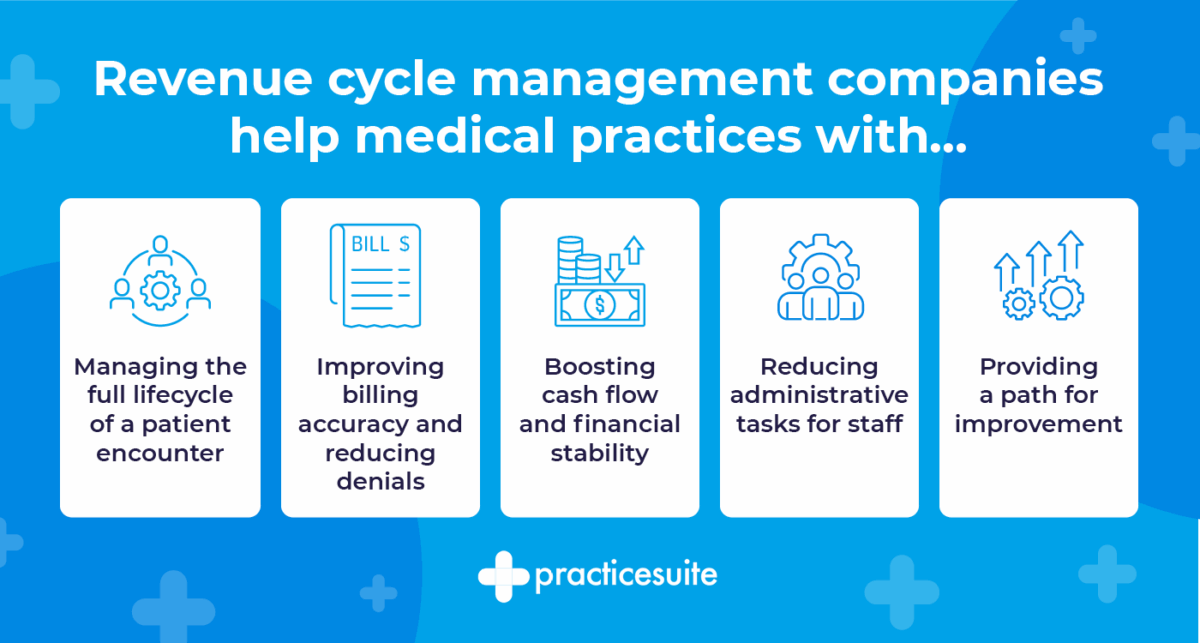
- Managing the full lifecycle of a patient encounter: This includes pre-visit tasks (like insurance eligibility verification, prior authorizations, and patient responsibility estimates), mid-visit tasks (like medical coding), and post-visit tasks (like claim submission, denial management, and collections).
- Improving billing accuracy and reducing denials: Software minimizes human errors and automates certain parts of the revenue cycle, resulting in improved billing accuracy and fewer claim denials. For instance, an RCM company may provide coding assistance or coding reviews to ensure any claims you send out are coded correctly.
- Boosting cash flow and financial stability: When you partner with an RCM company, you access tools that result in a more streamlined revenue cycle process. This results in more revenue for your medical practice and greater long-term financial stability.
- Reducing administrative tasks for staff: Without partnering with an RCM company, all RCM tasks fall to your staff members. Depending on the size of your practice, the number of patients you see, and the number of employees you have, handling all your RCM processes can be overwhelming. Working with an RCM company allows you to outsource these tasks, reducing the workload on your staff members.
- Providing a path for improvement: Certain RCM companies offer data collection and analysis, which allow you to access strategic, actionable insights you can use to adjust your RCM approach. Through data, you can identify any revenue leaks and operational inefficiencies, providing a concrete path for improvement.
The specific solutions offered vary from company to company. As a medical staff member searching for an RCM company to work with, research top providers thoroughly to make sure that the company’s offerings align with your needs—more about this in the next section!
What to Consider When Choosing an RCM Company
When choosing an RCM company for your medical practice to work with, consider the following:
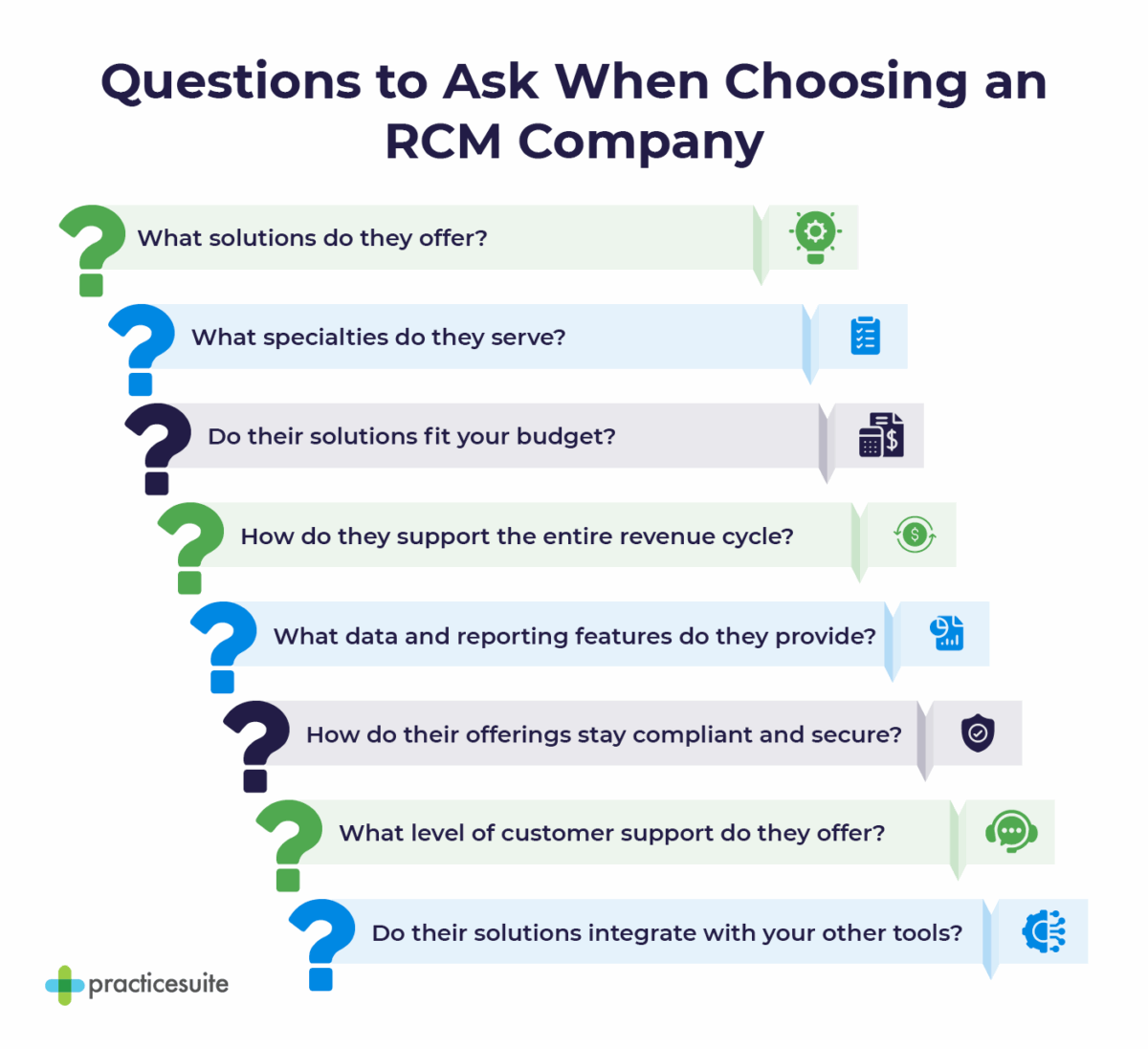
- What solutions do they offer? Determine what software the RCM company provides. Assess if they align with your medical practice’s most essential needs. If they address smaller obstacles you’ve been having trouble with, that’s a bonus.
- What specialties do they serve? If your medical practice has a specialty that requires specific RCM features, consider if the provider you’re researching offers features that align with your needs. For example, behavioral health clinics may need support for telehealth billing for a high frequency of sessions.
- Do their solutions fit your budget? Your medical practice’s budgetary restrictions are an essential factor in your research. Look for RCM companies that offer scalable solutions that can be tailored to your price range and specific needs. These companies allow you to pay for the features you need and add on additional features later on, when you have the funds to do so.
- How do they support the entire revenue cycle? Some RCM companies specialize in offerings for particular stages of the revenue cycle. However, if your goal is true oversight of your entire revenue cycle, you must look for a solution that supports all tasks related to your practice’s ability to get paid.
- What data and reporting features do they provide? Determine how easily you can access real-time metrics to make informed decisions about your practice’s revenue cycle.
- How do their offerings stay compliant and secure? We don’t need to tell you that the medical industry has stringent rules regarding data security. During your research, focus on how the RCM companies stay compliant with local and federal privacy regulations, such as HIPAA.
- What level of customer support do they offer? Purchasing and using any new software solution is daunting. Ideally, you want your provider to offer onboarding and training so your employees are well-informed about using their new tools. After onboarding, having 24/7 customer support is another huge bonus, so you can contact the provider directly whenever you have questions.
- Do their solutions integrate with your other tools? If you already use certain medical software, such as an electronic health record (EHR) tool, scheduling software, or a telehealth platform, your RCM tools should be able to integrate with them. This ensures that your data flows properly from one platform to another so you can accurately understand your practice’s financial health.
If you’re unable to answer these questions from your research alone, bring them into any demos or customer calls you book with the RCM companies you’re interested in working with. The product specialists should be able to answer these questions easily and help you determine if their offerings are the right fit for your medical practice.
Additional Resources
Boosting and optimizing your medical practice’s revenue can feel overwhelming, which is why having a dedicated RCM company’s help can be extremely valuable. Look for a company with offerings that align with your goals, and go from there.
Interested in learning more about running a medical practice? Explore these resources:
- 20+ Best Medical Billing Software Solutions. Billing is a core part of the revenue cycle. Discover top solutions to streamline your medical billing processes.
- The Top 10 AI Medical Billing Software Solutions. Want to leverage the power of AI for your medical practice’s billing? Explore the top AI billing solutions in this guide.
- 10+ Top Medical Practice Management Software Tools. Aside from patient care, you must also take care of tasks related to management, administration, and finances. Check out our recommended tools for practice management processes.
*The information published on this page is based on independent market research conducted on May 14, 2026. The content presented is intended to be objective, accurate, and reflective of the information available at the time of publication. PracticeSuite makes no representations or warranties regarding the accuracy or completeness of the information presented, which is provided for informational purposes only.
If you identify any inaccuracies, updates, or changes to the information provided, please contact us so we can review and update the content as appropriate.